

I have a confession to make. Before becoming an MP, I had only attended a single Liberal Democrat Conference.
It tended to clash with busy periods with work, or election campaigns where I just wanted to be out on doors, speaking to the public. I didn’t have anything against it - but despite being embedded in politics, I have to confess that to my younger self it seemed like a less than useful way to spend a weekend.
So I can understand why, to those outside of politics, party conference season might seem like a bit of a waste of time, particularly for MPs. Spending a few days by the seaside on yet another break from Parliament so soon after the summer recess, surrounded by people who think like you, can’t be very stimulating or worthwhile, right?
I’m going to try to persuade you it is.
Having time set aside to properly reflect on party politics, policies and the fundamental reasons we do the work we do as politicians is hugely important - but for an MP, there’s another critical reason why attending party conference is important. If you engage and put the effort in, these handful of days each autumn (and spring, in our party) provide so many opportunities to meet the stakeholders, campaigners and decision-makers who can make a real difference to your constituents’ lives.
So, to be the best MP I can be, I think it’s important to grasp the opportunities conference offers, and have the meetings, debates and big-picture discussions about the issues facing my constituents that don’t get the time and space they deserve in the hectic (and very dysfunctional) world of Westminster.
I got involved in politics to fix things. When I look back on the shouting-at-the-telly moments that convinced me to go on this journey, so many of them were about the utter lack of long-term planning, evidence-based decision-making and willingness to have the big-picture debates over things like infrastructure that will reveal the answers we need to make a difference to everyone’s life. It’s why I always try to bring my technical experience, and hunger to put evidence back at the heart of policymaking, in service of my constituents.
I promise that this isn’t technocracy, but rather it’s my take on liberalism. I know we can only arrive at the right answers on so many of these questions by hearing from a wide range of voices clash with one another, test their hypotheses and win or lose the argument in a truly democratic way. Liberalism and the scientific method have that in common. So as far as I’m concerned, the melting pot of activists and thinkers, industry, business and yes, lobbyists, all concentrated in one place, is a great opportunity to put that principle in action.
What I’m learning each time I attend Conference is that taking that opportunity effectively requires three different modes; listening, collaborating and communicating.
Listening


The exhibition hall is where charities, Lib Dem groups and organisations come to promote their causes, and catch the attention of MPs, Councillors and activists. This year I had hundreds of requests from local residents to meet with many such organisations, and made sure that I was able to make time to spend a couple of hours touring the hall and understanding each groups’ concerns.
Some of these are existing organisations within the Liberal Democrats. These are groups like the Lib Dem friends of Hong Kong and the Lib Dem friends of Ukraine, whom I met to hear more about their work to keep those fleeing war and persecution safe in the UK, or the Green Liberal Democrats and the (fabulously named) LibSTEMM who are both making a fascinating case about the role of innovation, and how policymakers can support it, in tackling the challenges we’re facing.
Others are charities with real pedigree in fighting for changes in the law, in particular around fixing our broken healthcare system. I met with Alzheimer’s Research UK, Young Lives vs Cancer, Dementia UK, Cancer Research UK, The Epilepsy Society and Arthritis UK - all with different but related stories to tell about the work they’re doing to support people through our broken healthcare system and champion the research that could change everything, and campaign requests to help them continue their work to benefit my constituents.
Then there are the campaigning groups - like Animal Free Research UK, who are spearheading a campaign for Herbies Law, which would put the UK on a ten-year course to phase out animal testing in medical settings. Whether it was groups like the WASPI campaigners voicing their concerns about the government’s failure to implement the findings of the ombudsman relating to pension changes for women, or those simply pushing for investment in green technology like the MCS Foundation (who outlined the benefits of transitioning to heat pumps and energy storage systems), these groups were punchy, bold and brave with their advocacy.
On that note, it would be remiss of me not to mention Surfers Against Sewage, who organised a particularly powerful way to demonstrate the scale of the water crisis and the need to urgently invest in our infrastructure; a litter pick on the iconic seafront of Brighton beach, which I found surprisingly sobering to take part in.
And then there’s the public sector or arms-length bodies who provide invaluable insight into what is really going on with the systems and processes that govern our country. It was great to catch up once again with the Law Society about the importance of London as a worldwide centre for legal services and the rule of law, and to take part too in a roundtable with London Councils and some of our London Liberal Democrat Council group leaders to discuss our position on devolution for London - including options to fight for a stronger settlement for London as part of the Government’s new devolution legislation.
But some of the most engaging moments and opportunities to talk about real change came from the businesses and trade groups who took part. In my role as London Spokesperson, I met with London and Partners to talk about how they support London-based businesses to grow and trade around the world, as well as encourage inward investment into London and keep our city an attractive place to do business in this difficult age of Brexit and the Cost of Living Crisis.
Sticking with devolution - I also met with the Urban Transport Group to discuss the challenges and opportunities for transport in London that the new legislation might provide. In fact, transport was (as anyone who knows me well will not be surprised to hear) a recurring theme - and I really enjoyed meeting with London Gateway/DP World to talk about the challenges for big infrastructure providers and operators to deliver growth, with Manchester Airport group to discuss their progress towards decarbonisation, and with Govia Thameslink Railways about improvements to rail services in Sutton and across London.
So, whilst it is exhausting to spend every day with a calendar as full as a raffle-hamper, I’m finding each year that the chance to take the time to really listen to and engage with these disparate and diverse groups proves to be unbelievably helpful.
Collaborating
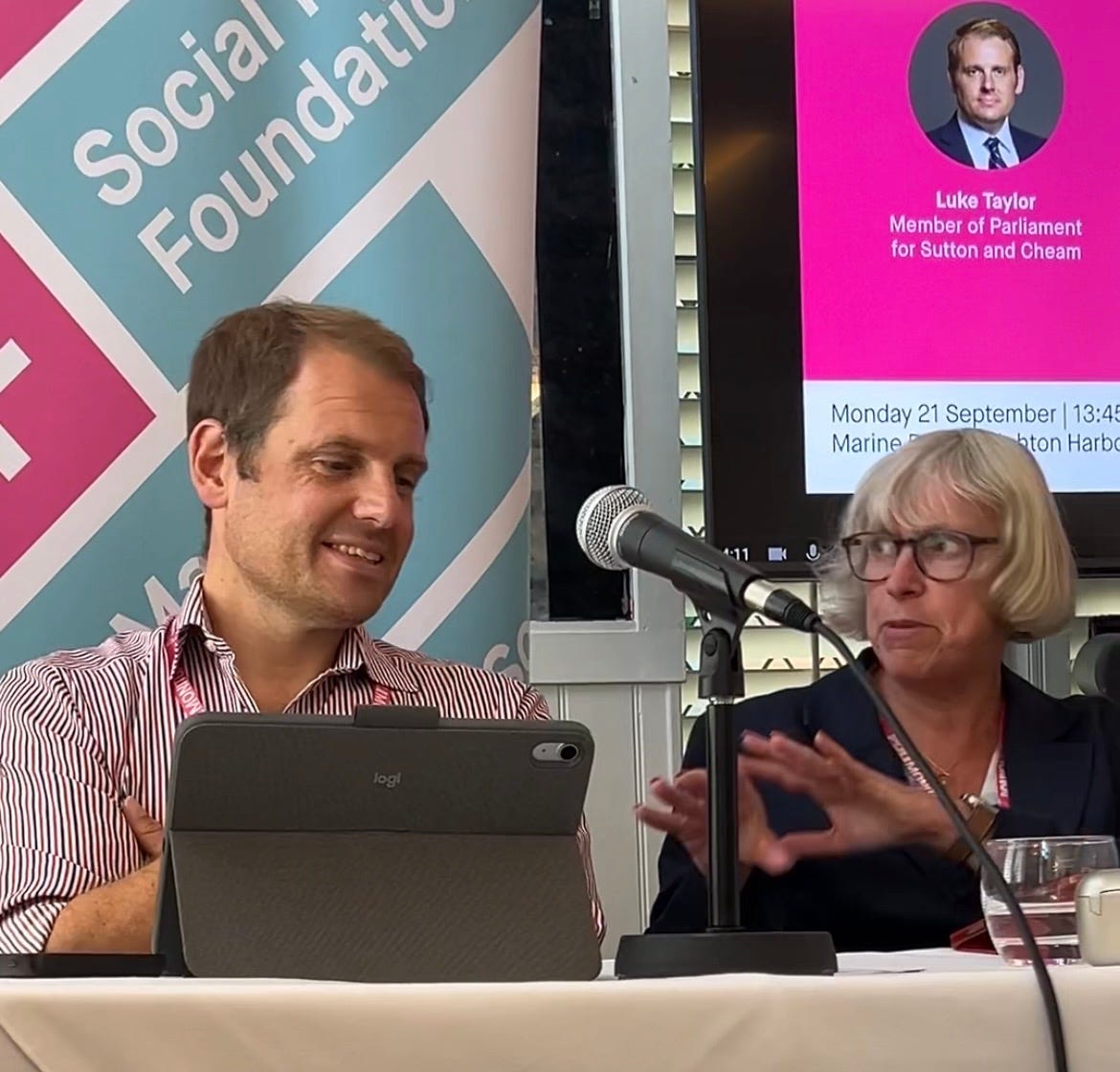
I know this isn’t how the maxim is supposed to be used, but to invert a famous Americanism, when it comes to Liberal Democrat conference, politics doesn’t stop at the water’s edge. If anything, you have a greater chance to take stock of the big picture and work together with colleagues to come up with the political case the country needs.
Each morning we met as a Parliamentary Party to discuss the upcoming debates in the chamber, talked about policies that colleagues would be working on, and also what issues were in the news that we would need to respond to, as the world doesn’t stop while we sequester ourselves away by the seaside.
Every lunchtime was a working lunch with key party activists from across London, who I support in my role as London Spokesperson to develop their campaigns and help more residents across the city. For the record - I don’t see that as in opposition to my role as a constituency MP - but as a way to feed back the challenges I see my constituents facing and compare notes with those running campaigns to fix similar challenges in other parts of the city.
And every afternoon and evening was chockablock with Fringe Events, including one titled ‘Winning Britain’s Cities’ where I was glad to have the chance to discuss something that is becoming a clearer part of our party’s strategy - the need to make sure we have a distinctive message in Green and Labour facing urban areas, and a clearer expression of what practical liberalism means for those living in cities in 2026.
Another was the launch of the Britain Project, a new thinktank which will help generate policy and debate to move our party forwards. It will be headed by Tim Leunig - who I also had the chance to sit down with to discuss how I can work together with them to design a refreshed, updated, truly liberal approach to better infrastructure, transport and business policies.
Some of these events I had the chance to host myself - including a roundtable of industry experts on how to push the Government to support the decarbonisation of road transport, specifically fleet and logistics, and how the sector can play a role in boosting economic growth and UK manufacturing. It was interesting to hear about concerns from industry about the current approach to the ZEV mandate, eVED, and challenges with charging infrastructure. I also chaired a roundtable as part of “Business Day” with business and industry experts about Rebuilding Britain’s infrastructure, and attended one hosted by the SMMT about the automotive industry on how industry and government can partner to support innovation, employment and skills growth.
Communicating
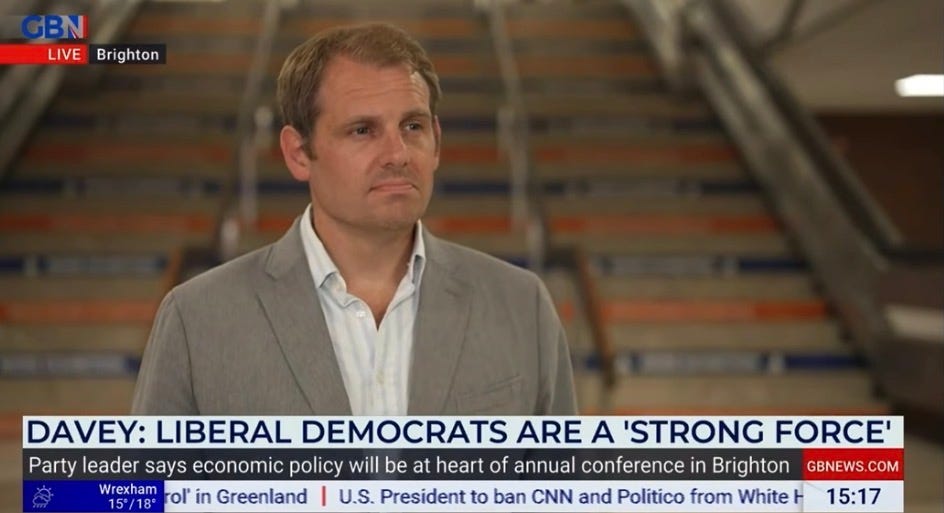
The irony of making this point in a somewhat lengthy recap aside, I believe that the things we learn at Conference and the message that is developed there needs to be broadcast to the world at every opportunity, or else we are just talking to ourselves.
Over the four days I spoke with…
GB News about the change the Liberal Democrats are really offering the country, and why Reform’s populism will just build the opposite of the future we need (I can’t imagine a particular primetime anchor of theirs will have liked that one).
Prospect Magazine to talk about what the new Burnham government meant for the Liberal Democrat party strategy going forward,
BBC Radio 5 Live and BBC Radio London on some of the important policies we passed at Conference, including the bold new approaches on defending democracy, standing up for businesses and empowering communities that the country so badly needs.
Iain Dale’s show on LBC to explain our centrepiece announcement of the conference - an increase in the income tax threshold to put more money back into peoples’ pockets, funded by what independent (and conservative) analysis demonstrates would be a huge bump in the public finances from rejoining the single market and customs union.
So why bother with this longer piece here on Substack? Because communicating the sheer scale of the work that goes on at party conferences is something that can get a little lost in the typical media circus that surrounds them.
Don’t get me wrong - big media moments and set-piece policy announcements are absolutely critical. But the wider culture of debate, hard work and connection-building that characterises these conferences is so important, and if anything it is undervalued in the normal analysis of how British Politics works.
In an age when Westminster is increasingly frenetic and unfocused, these conferences are one of the last real places to have real debates, let opinions clash in the best tradition of democracy, and make the connections with experts and industry we need to form partnerships that can change the country. They are the modern-day equivalent of our Enlightenment coffeehouses.
So for that reason I think lifting the lid on what goes on in a politician’s world over these unusual and breathless early autumn days is useful - because you deserve to know that we are working just as hard if not harder on the big issues facing the nation when we decamp each September to the seaside.